

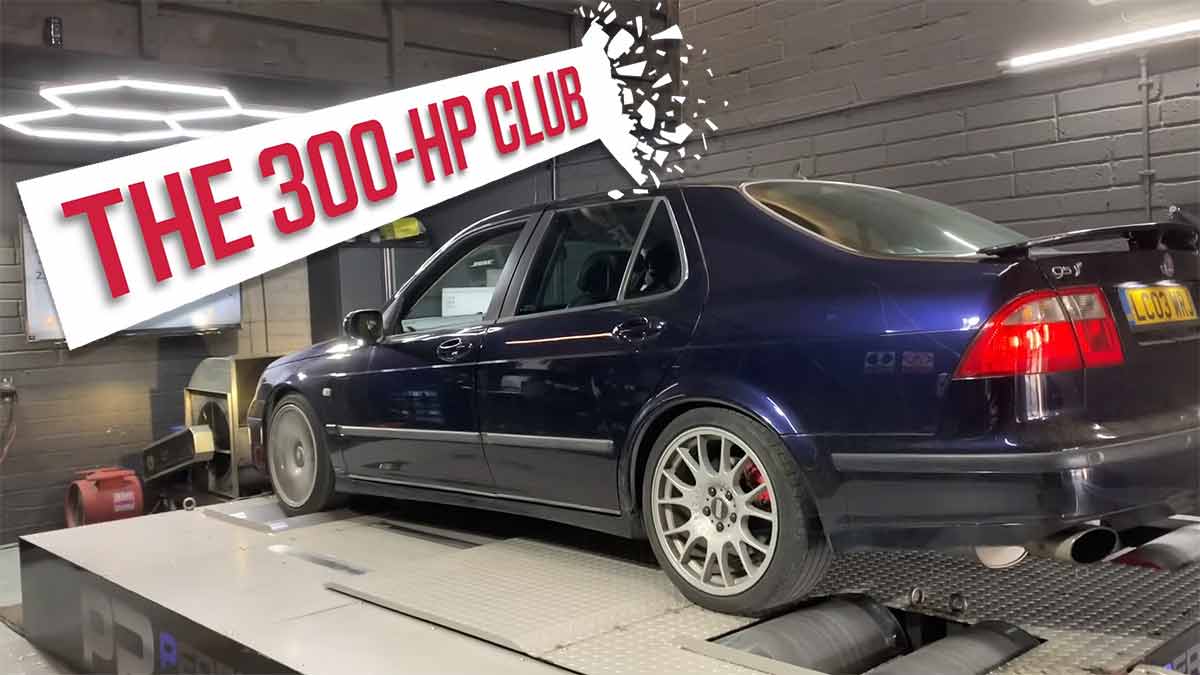
A £1,800 Saab 9-5 Aero That Shouldn’t Be This Quick
Geoff Thompson has already shown our readers what happens when you send a high-mileage Saab 9000 on a 550-mile shake-down trip and then put it on the dyno. In this new chapter, the focus shifts to a different car altogether: a Saab 9-5 2.3T Aero manual, roughly 20–21 years old, bought almost on impulse from Facebook Marketplace for £1,800 to stop it being broken for parts.
The seller had drawn a line at that price, explaining he could get more by parting the car out. Geoff’s answer was straightforward: he would take it at £1,800 precisely so it wouldn’t be scrapped. Nobody else stepped up. The comments ignored it, the ad sat there, and a very serious 9-5 Aero slipped under the radar.
From the first drive home, Geoff knew this wasn’t just a tired stock Aero with decent cosmetics. He describes it as “one of the fastest cars I’ve ever driven”, and that statement comes from someone who spends much of his time around performance machinery, Volvos, fast Audis and various tuned projects. The Saab felt stronger than the numbers in the listing and definitely stronger than a stock 250 hp Aero.
So the next logical step was obvious: take it to the dyno and find out why it feels so “flippin’ fast.”
Back to Performance Remap: Geoff and Chris Reunited
For the power test, Geoff returns to Performance Remap, the same dyno shop where he has already run a fleet of older cars for his audience. Chris is at the controls again, handling the strapping, the runs, and the data.
The goal this time is clear and narrow:
- Confirm what this 9-5 Aero actually makes at the wheels and at the crank
- See whether the seller’s claim of around 295 hp is realistic
- Understand why the car feels so much stronger than a lightly tuned daily driver
On paper, a stock 9-5 Aero of this vintage is rated at 250 hp, with the familiar 2.3-liter turbocharged four-cylinder pushing a fat torque curve through a manual gearbox. But this particular car already shows signs of having been thoughtfully modified.
What’s Hiding Under the Skin: The Hardware
Before the first pull, Geoff and Chris walk around the car and start picking out clues:
- 18-inch motorsport-style wheels with BBS center caps
- A Mij performance exhaust, which gives the car a more urgent tone
- Hard-piped boost plumbing, instead of the standard rubber sections
- An obvious aftermarket downpipe, part of a typical stage-style tuning package
- A likely uprated intercooler, though partially obscured by another car on the ramp
- A small additional badge on the rear that Geoff freely admits he doesn’t recognize, inviting viewers to decode the car’s history better than he can
Inside, the car gets the usual Aero comforts – including heated seats – but this specific one goes further with heated rear seats, something Geoff’s kids quickly latch onto as a non-negotiable argument for keeping the car over winter.
Nothing about the package screams “wild build” or show-car excess. It looks like a typical fast Saab someone has quietly sorted over the years: proper exhaust, proper pipework, likely intercooler, and a map to tie it all together.
Strapping Down a 21-Year-Old Aero
The car is around 21 years old and shows 135,000 miles, which is hardly low but also far from catastrophic for a B235R that has been maintained and treated sensibly. On the way to the dyno, Geoff fills it with BP 97 octane premium, and Chris immediately suggests that Tesco 99 would be an even better choice – more octane, often cheaper, and genuinely good fuel for turbocharged engines.
Once the 9-5 is strapped to the rollers, the usual quirks of modern ABS systems show up. Because the front wheels are spinning and the rear wheels are stationary, the ABS logic essentially decides something is wrong, shuts itself down, and the speedometer stops reading. On the road everything returns to normal; on the dyno, it simply underlines how these cars were already deep into the ECU-and-sensor era.
Geoff and Chris agree on the plan:
- A couple of warm-up runs,
- Then three or more full pulls in top gear,
- Monitoring wheel horsepower, calculated flywheel horsepower, torque, temperatures, and any signs of stress.
The exhaust has a slight blow, likely from a suspect stud and a visible gap in the downpipe area, but nothing catastrophic. Temperatures stay under control, there’s no smoke, and the engine behaves exactly how a healthy tuned Aero should behave.
The Numbers: From Wheel Horsepower to Engine Output
The dyno session progresses the way experienced tuners expect: the first run is lower, subsequent runs climb as everything comes up to temperature.
Key numbers from the session:
- Early pull: around 230 wheel horsepower
- Second run: 246 wheel horsepower
- Later runs: 257–259 wheel horsepower at the wheels
Chris’s dyno software then calculates the engine horsepower from those wheel figures. On the final, stable runs, the 9-5 Aero shows:
- Approximately 295–302 hp at the engine
- Peak torque close to 490 Nm
In other words, the car is right where the seller claimed it was – maybe even a touch stronger. Geoff had been told to expect around 295 hp, and the dyno backs that up with numbers that touch 300 hp and slightly above on the best runs.
For a 20-plus-year-old Saab that left the factory at 250 hp, those results are serious but not absurd. They reflect a car tuned by someone who understood the platform: exhaust, intercooler, pipework, mapping, and presumably decent maintenance.
Why It Feels So “Flippin’ Fast” on the Road
Numbers alone don’t explain the way this car behaves when Geoff puts his foot down. The dyno confirms about 300 hp and 490 Nm, but what he keeps stressing is how the car delivers that performance.
A few factors stand out:
- Strong mid-range torque: 490 Nm in a front-driver or lightly loaded chassis means real urgency from mid-rpm onward.
- Manual gearbox: No torque converter losses, direct control over gear selection, and better use of the engine’s best range.
- Well-set map: The car doesn’t feel like a crude overboost monster. It feels consistent and composed, which is often a sign of a tuner who knows how to keep knock control, AFRs and intake temps in check.
- Sorted supporting mods: Hard pipes, intercooler and exhaust all help the turbo breathe and stay within a temperature window that allows repeated pulls without power falling off.
Geoff talks about the difference between a car being theoretically quick and real-world quick. A modern RS3 with 430 hp is brutally fast, but also heavy, complex and operating at power levels where you rarely use the full potential on public roads. The Saab, with around 300 hp, sits in that sweet spot where you can actually deploy a lot of its performance without the car turning into a constant traction-and-stability fight.
That’s why this old 9-5, bought cheaply and tuned sensibly, feels like one of the quickest personal cars he has brought to Chris so far.
Old Saabs vs New Engineering Problems
In between the dyno runs, Chris and Geoff drift into a familiar topic: modern engineering “solutions” that create new problems. Chris mentions Transit vans where water runs down the windscreen, through the drains, and straight onto the ECU. They talk about wet belts, fragile emission setups, and ECUs that dealers cannot even communicate with once a previous mapper has made a mess of the software.
Chris offers an example of a Porsche 911 that failed emissions even after the owner refitted OEM catalytic converters. The root cause turned out to be an aggressive remap that had completely upset fueling. Only after reinstalling a factory map did the car finally pass its test, with the Lambda reading dropping from 0.8 down toward the required range.
Against that backdrop, the Saab 9-5 Aero looks like a clear, rational package:
- Known platform
- Straightforward hardware tuning
- An ECU that can still be read, understood and adjusted
- A car that passes the basic common-sense test of being usable, fixable and still engaging to drive
Add to that a Range Rover daily that, in Chris’s case, has survived 8,000 miles without issues and a main dealer service bill that wasn’t outrageous, and the conversation ends up painting a nuanced picture: not all modern cars are disasters, but an old, sorted Saab with a careful tune is a very safe place to put your money and enthusiasm.
300 Horsepower, Heated Rear Seats and a Future in the Family
Once the numbers are printed – 295, 299, 302, 301 hp and around 258 wheel horsepower on the best runs – Geoff does exactly what a Saab owner with a strong dyno sheet should do: he puts the graphs in the history file and starts thinking about keeping the car.
The decision is helped along by his children. After one school run in the back of the Aero, they discover the heated rear seats and immediately vote to keep the car for winter. For them, the argument is simple: warm backs, comfortable cabin, plenty of shove when dad joins the motorway.
For Geoff, the picture is slightly more technical:
- A 21-year-old Saab 9-5 Aero
- 135,000 miles
- Bought for £1,800
- Making around 300 hp and 490 Nm on a trustworthy dyno
- With the right hardware, the right map and the right feel from the driver’s seat
Put all of that together and you get exactly what this video proves: age and mileage don’t matter much when a Saab has been modified intelligently and maintained properly.
Watch the Full Dyno Session
To see the entire process – from the cold drive to Performance Remap, through the inspection of the hardware, to the repeated 300 hp pulls – watch Geoff’s video here:
And if you enjoyed this story, you can also revisit Geoff’s earlier Saab adventure, where his Saab 9000 was driven 550 miles and then tested on the dyno, in our previous feature: Geoff Thompson’s Saab 9000: 550 Miles, One Tank, and a Dyno Sheet
This new 9-5 Aero simply continues that theme: well-bought, well-used, and still very much capable of delivering the kind of power that keeps Saab owners coming back for more.





Yeah, very nice. I’m not surprised. Can I ask a question? I don’t know about the 95 model, but the SS 93 manual says to use 95 octane petrol for best performance. Does anyone have any experience with using 99 octane?
To Robert Franczak > use the highest octane you can get
J ai eu la meme